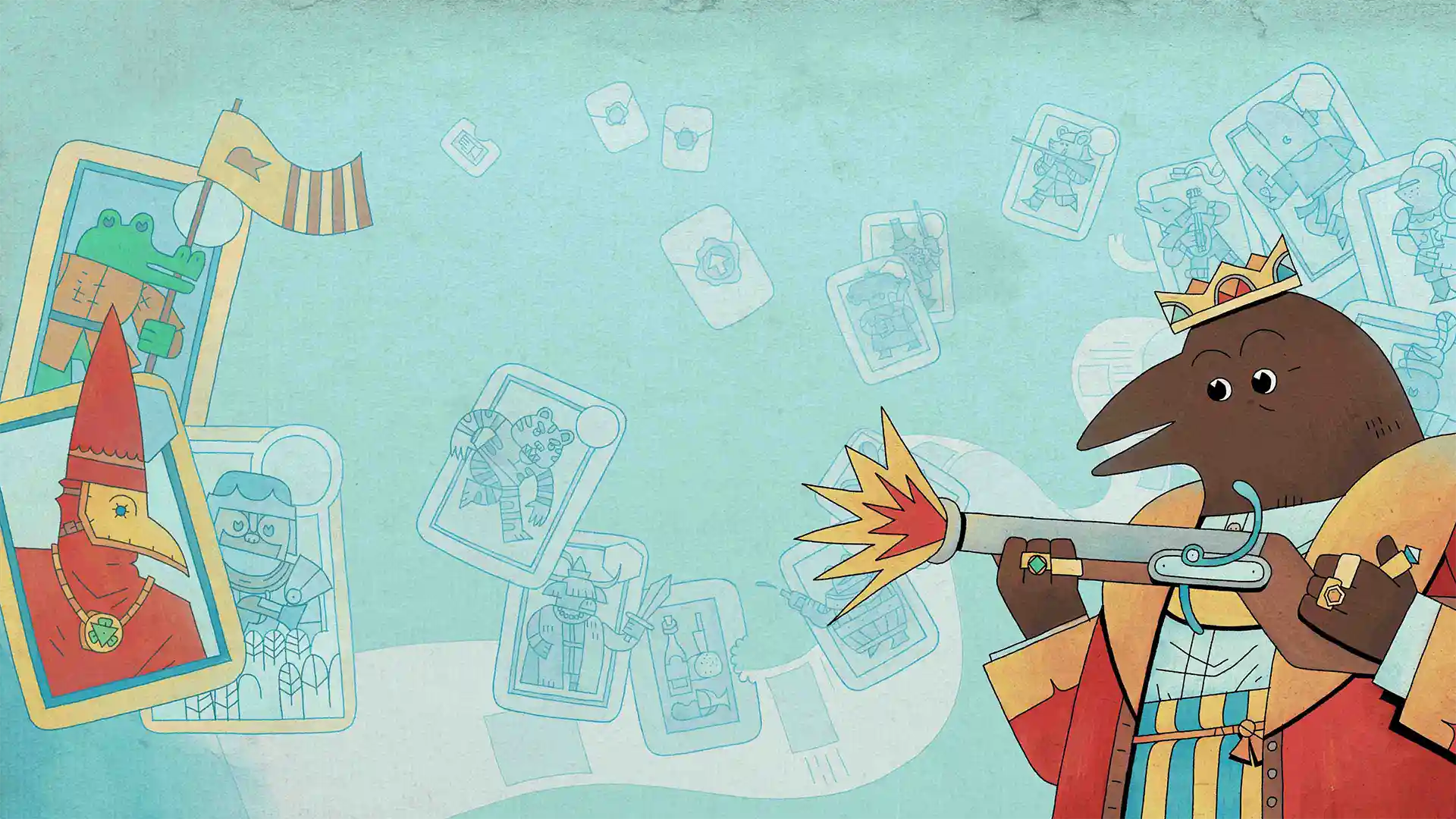
The most striking thing about Knock on the Coffin Lid (KotCL) is how wonderful it looks, so let’s start there. This roguish deckbuilder from RedBoon has been made with such care, and the attention to detail that has been paid in nearly all aspects of its creation has constantly impressed me. It looks like a comic book come to life, with a striking art style, animated backgrounds full of rich detail, and characterful designs full of personality.

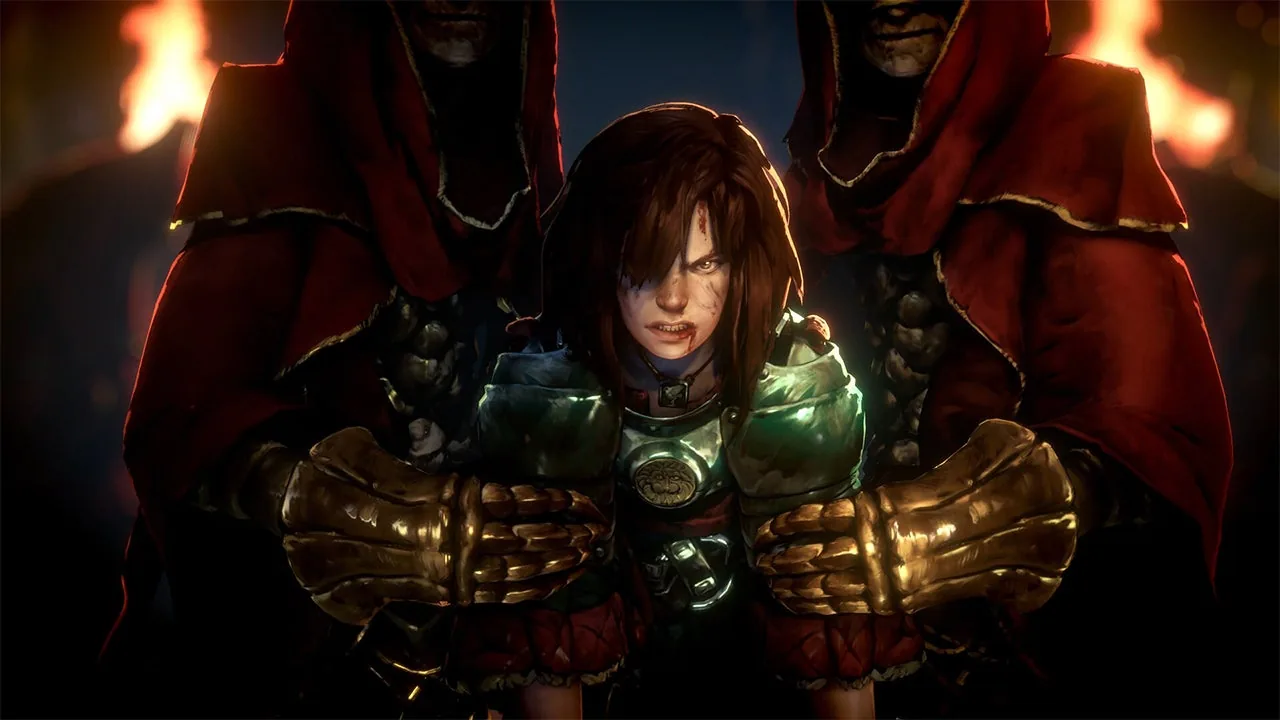
KotCL is a set in a deep and complicated medieval fantasy world full of competing factions, Witcher-esque moral greyness, and hundreds of enemies who are out to end your miserable existence again and again. Playing as Percival (at first; there are two more characters to unlock) you start off the game betrayed, wronged, and most definitely dead. However, you are awoken from your not-so-eternal slumber by a dodgy-looking dude called Mortis.
In fact, the tap tap tap of Mortis waking you up is where the game gets its name, and every time you fail in your quest and die – and die you will – you wake up in the same coffin, ready to start your mission again under the guidance of your mysterious benefactor. It’s a neat twist on the typical deckbuilder formula that allows RedBoon to deliver a deeper narrative than you normally find in a game like this.
Combat in Knock on the Coffin Lid
While the narrative is the beating heart of KotCL, the card-playing combat also has a lot going on and offers plenty of versatility to explore. Deckbuilder fans will find their feet pretty quickly and it’s more accessible than most. In fact, I think it would make a good entry point for people new to the genre, especially those who prize narrative highly.
I was playing the game on normal and, most of the time, I felt like enemies were fairly beatable and it didn’t take me long to overcome them with fairly unremarkable tactics. That said, KotCL is, I think, a bit of a power fantasy, and you’re not supposed to struggle against the proverbial cannon fodder. Instead, the real challenge comes when you’re taking on the named characters.

When contesting a combat encounter, Percival and company have a limited supply of energy that can be spent on playing cards and committing to actions during battle. During each round, you invest your energy into either attack, defence, or to make some other play that boosts your stats ahead of a subsequent action.
Attacking your foes is at the heart of things, but you also need to pay attention to the intentions of your enemies. If they’re about to attack you can play some cards to block the incoming damage. If they’re not attacking at all, maybe now is a good time to play a card that boosts your energy and lets you draw additional cards. Combat is fast and reasonably fluid, and it doesn’t take long before you’re stringing together well-ordered attacks that deal devastating damage.
Despite Percival being overpowered in comparison to most of his enemies, there are nuances that must be examined during the boss battles. For example, there are status effects such as strength (that can boost your damage), barbed (which cause bleeding), and evasion (that lets you dodge entire hits). Once you’ve worked out how everything fits together, you can start to assemble a deck of cards to reinforce your strategy.

Equipped for the journey ahead
If you know your way around the deckbuilder genre, you may find the opening exchanges in KotCL to be quite manageable. That said, there is a challenge to be found if you want it, and surprising depth tucked away in nearly every gameplay system. In particular, things get really interesting when you start leaning into the game’s RPG mechanics, specifically those involving weapons and gear.
Your character can use armour, amulets, and other such items, to be bought and sold at stores and scavenged after battle. These items give you various stat boosts and equipping the right combo can be hugely beneficial. There are several item sets and the more of one type you equip, the more bonuses they confer. For example, when worn together, the elven armour, boots, and sword can give you additional evasion bonuses, helping you avoid incoming damage.

There are times when certain items can work against you. I had one battle where the hat I had equipped essentially caused me to lose strength and gain agility, which meant that my enemy, a cannibalistic butcher who morphed into a demonic man-boar, got increasingly powerful. All I could do was add shield after shield while my attacks got weaker. Eventually, I had to scrap my entire run because this one battle just wouldn’t come to an end.
The aforementioned hat was the exception and not the rule, and for the most part I was impressed by how the gear system worked. You can swap your sword for an axe or a hammer, and your gear then appears on your character during combat. What’s more, certain weapons add new cards to your deck, and so having the right sword can really emphasise the better aspects of your build, giving you more tactical options during combat.
The gameplay loop
Much of your time is spent in battle, but there’s also a choose-your-own-adventure style narrative that underpins things. The game’s various regions each have multiple pathways through, but unlike many games of this ilk, a lot of these encounters are fixed on the map, and once uncovered, you know where things are going to happen.

There is some variance around these events, but the game’s narrative requires a bit more predictability than you would normally expect from a roguelike deckbuilder. It wasn’t a problem for me, and I think even with fixed events there’s enough depth and potential gameplay variety to support different playstyles across multiple playthroughs.
Not only that, but the different characters and their respective alt playstyles will encourage very different experiences. Percival’s first unlockable build is a great example, as it puts a huge emphasis on the economy of the game. Suddenly, you’re earning gold during combat and then spending that gold on blocking and attacking. KotCL supports a variety of tactics, and the different classes will force you to explore the game’s nuances.
In terms of its roguelike mechanics, Knock on the Coffin Lid does a decent enough job, even if it doesn’t quite match up to the best in the business. However, RedBoon has woven card mechanics into an adventure that, in terms of story, surpasses nearly all of its peers. It’s not your typical roguelike deckbuilder, but I think there’s definitely a place for it, especially for those of you who want a bit more narrative than we’re usually dealt in this genre.
Knock on the Coffin Lid is out now on Steam PC (Mac, Win). I played the game via access provided by the developer, so thanks for that. There’s also a newly announced DLC which you can read about here.
Finally, as a postscript of sorts, I would like to add that KotCL is constantly being updated, and while I experienced no technical problems because of this, the developer has repeatedly warned that this might happen. There’s also no controller/Steam Deck support at the time of writing, which feels like a bit of a missed opportunity.