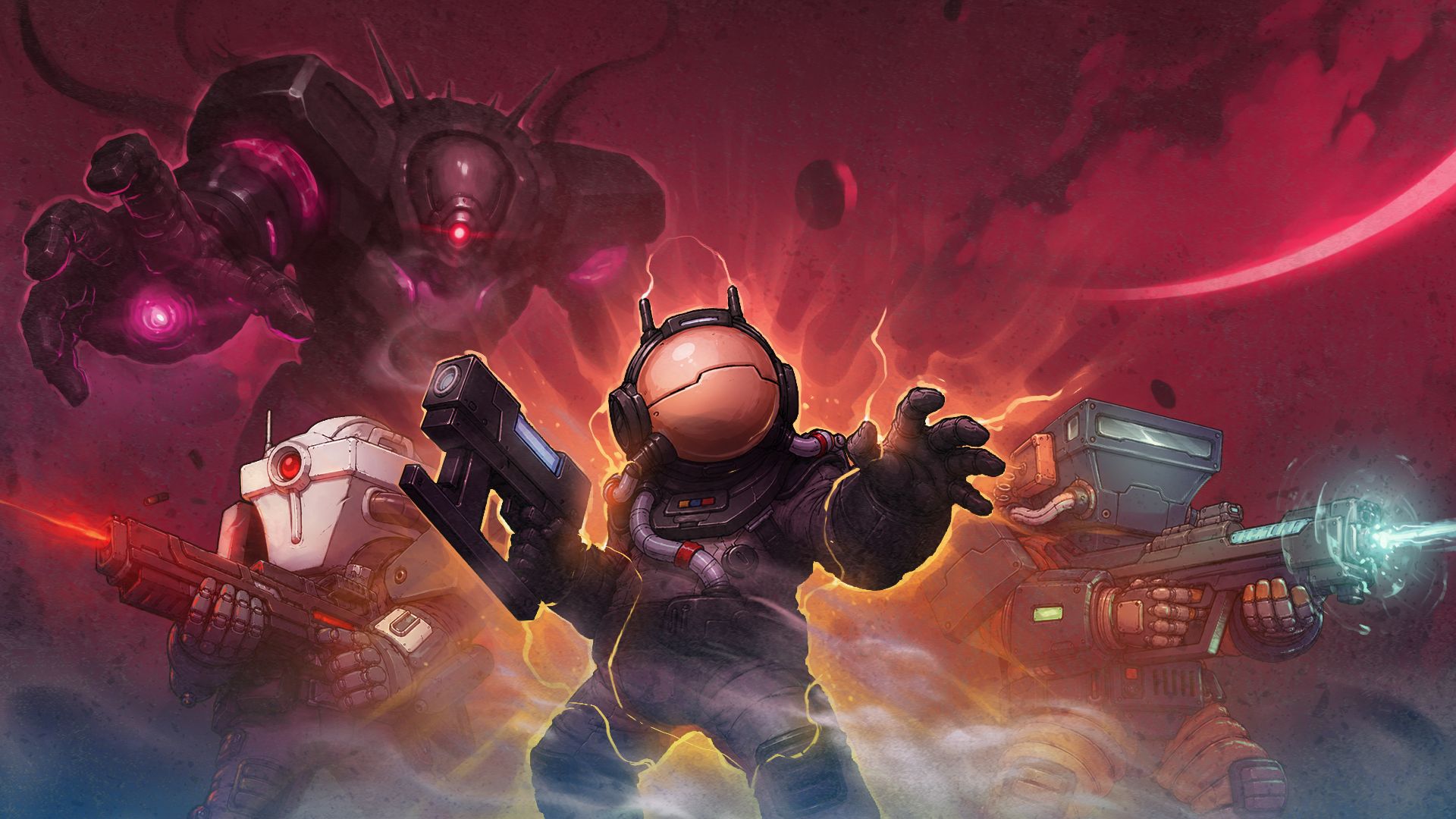
In Arc Seed, the new mech-infused deckbuilder from Massive Galaxy Studios, you must pilot a giant mech and smash the living crap out of monstrous alien Archangels that are attacking Earth. As far as setups go, this one is solid gold and I’m already well on board.
Despite loving the background narrative, it became clear while I was doing my due diligence for this article that Arc Seed is somewhat reverent to Neon Genesis Evangelion, a Japanese TV series from the ’90s about metallic Angels that descend on Earth with ill intentions.
I’ve not actually seen the show, so I’m sure that there are nuances that I’ve missed, but I have piloted a fair few digital mechs in my time, so hopefully my account will be of use to those of you interested in knowing more about the game.
Getting ready for combat
The Early Access build that I played is far from complete, but there’s still plenty to tell you about. For starters, you’ll split your time between combat encounters that take place in huge cities, and upgrading your mech ahead of the next battle.
Not all aspects of the strategy game are present yet and there are several sub-menus still under construction. However, you can repair any damage taken in the previous battle, swap out weapons, enhance your base stats, and buy cards to play in future battles.

Your progress here doesn’t carry over if you die, but there is meta-progression in the form of the Arc Pass. As you earn points you move through several levels and unlock new things, such as a second mech called the Titanfist.
The battles are where everything comes together, and you’ll move your giant mech down long city streets before squaring up to the aforementioned Archangels. Your mech has a finite pool of energy, and on each turn you can spend a portion of that energy on taking actions. These actions can be chosen from a selection of cards in your hand, drawn from a curated deck.
Level traversal takes up a chunk of the early part of any encounter, as you and your enemies move into position for combat, and this can mean that things take a little while before they heat up. However, once battle ensues, I found the combat system to be pretty snappy and quite rewarding, although there were a few moments of frustration when I made mistakes and ended up committing to actions that I absolutely didn’t want to take.
Mechs smashing mechs
Each turn sees you dealt a selection of cards from your deck. You start with three action points and can spend them on boosting your shields or dashing across several tiles, for example. There are charge points all over the city that you can use to replenish spent points, and as you have a finite pool of energy, it’s worth integrating the positioning of these charge points into your overall strategy. The last thing you want is to run out juice mid-battle.

Some of your attacks are determined by the weapons that you’ve equipped to your mech, but there are missile attacks and traps that aren’t related to those choices. You’re able to buy new cards and unlock others as you go, which means an ever broadening array of tactical options are open to you.
Personally, I quite liked using the railgun, which required two energy points, but did a whopping 10 damage. Another favourite move of mine involved me kicking my enemy back a couple of squares before blasting it with rockets and/or heavy bullets.
During combat, the city blocks around you are evacuated, with the outcomes abstracted to a meter that fills up: green for people saved and red for those who have died. The urban battlefields look like something out of Sim City 2000, and I really liked the retro pixel aesthetic, but I do think a bit more variety would make the settings feel more vibrant and alive.
What I didn’t like was the sometimes confusing navigation around the city, and I accidentally smashed up a few city blocks because of misclicks. At least there’s an “undo action” button, although it wasn’t working properly for the majority of my time with the demo.
Playing your cards right
The first chapter of the game is relatively easy, and I pushed through without too many issues (beyond those of my own making). Even the boss battle at the end wasn’t overly difficult, and my build was powerful enough to dispatch the titan, which split into three during our battle, without losing too many people.

The second chapter took me to Lisbon and a change of map, and things were instantly more challenging. In fact, it didn’t take long before my run was over as my enemies now had stronger shields and more powerful attacks. I tried making my best moves, but a lack of mobility made me a sitting duck and my upgraded enemies dispatched me more quickly than I care to admit.
As I contemplated my failed run, I came to the conclusion that Arc Seed has the potential to be a very good game, but it’s not there yet. As I alluded to in the headline, I can feel the influence of Into the Breach here, however, Arc Seed’s more expansive maps and the sometimes cumbersome traversal separates the two somewhat.
I really liked the game’s aesthetic, even at this stage in its journey through Early Access. It looks great, and the soundtrack is pumping, just like you’d expect from a game that draws so much from ’90s Japanese sci-fi. Sure, it’s rough around the edges and in need of refinement, but I think it’s on the right track.
In fact, I’d say that “on the right track” really does sum up where Arc Seed is right now. It’s still early days, but I see big potential here, especially if certain parts of the game can be sped up and the controls made less clunky. On the question of whether you should check it out for yourself, I’d say it really depends on how comfortable you are when it comes to Early Access and playing unfinished games. For what it’s worth, I didn’t experience anything game breaking, and while Arc Seed does need some polish in the months ahead, the foundations already feel solid.
The Early Access version of Arc Seed is out now on PC Steam, and I played the game via a code provided by the developer – thank you!