There are only so many ways that you can mix things up in the deckbuilder space, but Snake Tower Games has done just that with Moonsigil Atlas, a new card game that’s powered by celestial energy and a neat tile placement mechanic.
It doesn’t take too long to unlock the game’s three characters, and each one brings a distinctive deck to the proverbial table. Nothing too outrageous there. Then, armed with a starter deck and a growing understanding of the game’s systems, you must guide your character in a quest through the stars to take on mighty titans and save the galaxy itself.

What is Moonsigil Atlas?
Not only is Moonsigil Atlas a really solid deckbuilder with plenty of interesting synergies to unlock across its three decks, but it also has a tile-placement hook where smart thinking will define your efforts as much as the cards you’re dealt.
Things start on a star map, much like the one in Slay the Spire, and you must move between nodes and deal with whatever you encounter there. This might be a chance to upgrade a card or tweak your deck, or you’ll be invited to battle some giant celestial beast.

These battles take place over multiple turns, and you must play the cards you’re dealt during each turn as effectively as possible. You know the drill by now.
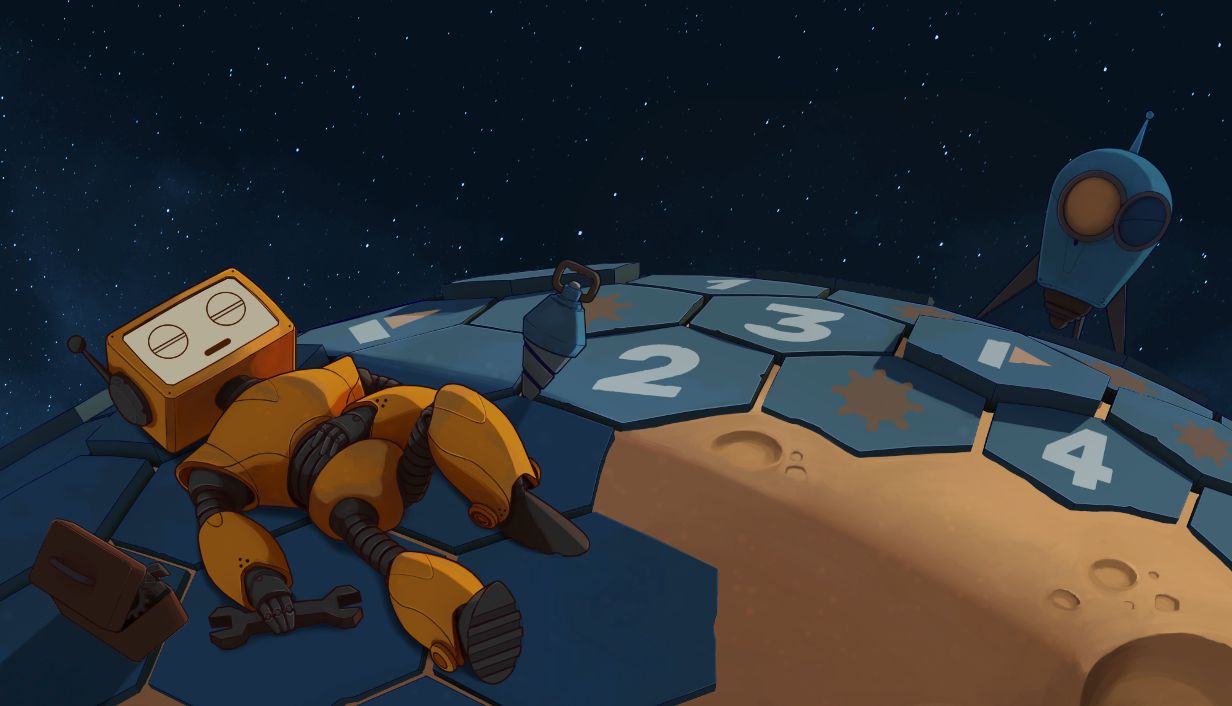
Basics aside, it’s not long before things do start to get a bit interesting. For starters, there’s a cool mechanic that links the movements of the moon in IRL to in-game artefacts. A novel touch.
A more substantial point of difference is the fact that there’s no mana pool or limited number of “action points”. You can play as many cards as you like, as long as they fit…
Each card in your hand denotes a shape, and when played, that shape must be positioned on the grid where each round takes place. It’s in the systems around this core mechanic that Moonsigil Atlas offers its most interesting ideas. If you’re like me and enjoy a good tile placement board game, I think you’ll probably enjoy yourself as you agonise over the positioning of your shapes, rotating them and trying desperately to make them all fit.
Star-studded combat
The turn-based combat is core to the experience, and I think it works really well. Each enemy (or group of enemies) will attack or play status effects, and you must try to block damage, inflict your own, and also find synergies between the cards that you are playing.

Enemies quickly begin to flank you, and your attack and defence must take their actions and positioning into consideration. The star-covered triangular grid is segmented, and you must position your pieces so that the right parts of each shape are in the correct segment. For example, a basic shield card/shape will have a rune on one part of it, and that effect will only be applied if the rune is in the correct segment of the grid.
Clever placement is everything in Moonsigil Atlas, and there’s no taking back a stupid mistake; my impulsive nature bit me on the bum more than once as I slammed down big shapes in the middle of the grid only to realise that I couldn’t play much else afterwards. If the shape can’t fit on the grid, you can’t play it, and even if you’ve got loads of cards in your hand, if you shit the bed and slap down an obnoxiously large shape and block off your next move, it’s tough, and you just have to end your turn and let your enemy have their swing.
Layered combat
Not only does there appear to be plenty of ways to develop a deck over the course of a campaign, but there are also interesting evolutions across the grid itself. Tougher enemies will start throwing down shapes, and they can have a variety of functions – none of them good for your health or wellbeing.
For example, you might need to cover each enemy shape with your own or take damage for each one that is left exposed. Or it could be the opposite: the more spaces you cover, the stronger buffs the enemy will have on its next attack, forcing you to think carefully about the implications of each card and where it is placed.
To counter these offensive challenges, you have abilities that persist over multiple turns. Some of your cards/shapes will linger on the board once played, which means you have to work around them on future turns, but they also offer ancillary benefits, such as damaging or weakening a certain enemy.

Is it written in the stars?
Moonsigil Atlas has just launched on PC (Lin, Win), and I’ve been playing via access kindly provided by the game’s publisher, Twin Sails Interactive. However, I’ve been keeping tabs on this one since last year, when I played a demo, before it was signed up.
My opinion hasn’t changed all that much in the meantime. I really like the tile placement mechanic, and I think that system elevates what is otherwise a decent deckbuilder, making for a more compelling loop.
It’s hard to comment on the balance of the different characters without playing dozens of hours, but the time I have spent playing has revealed three distinctive playstyles. I tried each one for a bit, but I eventually went back to the starter option so I could push deeper into the campaign.
The presentation in Moonsigil Atlas is pretty good, and the art style is vivid, and overall I found the experience pleasantly engaging. I am, however, a huge fan of tile placement board games, and that DNA runs strong here, so if that sounds good to you, I reckon you should check it out too. On the other hand, if you’re after a deckbuilder to rival the complexity and nuance of Slay the Spire 2, which many of you have played recently, the recommendation is less clear-cut (maybe try the demo first).