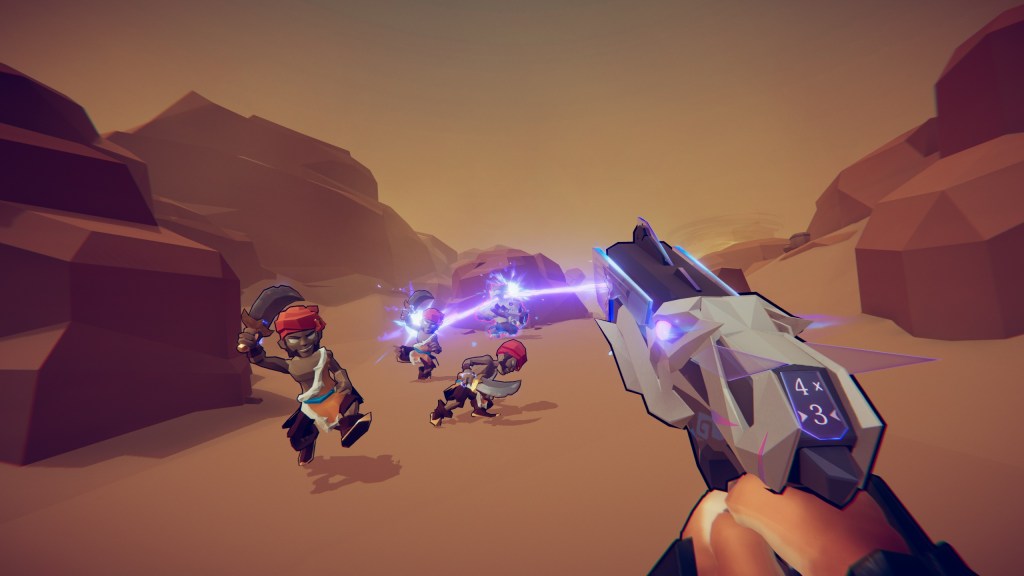
I’m not entirely sure how to pronounce Pyrene, but my ignorance has not stopped me from thoroughly enjoying myself for the past couple of weeks. This roguelite deckbuilder is the latest work from Two Tiny Dice, the indie studio that gave us Forward: Escape the Fold.
Pyrene is, in many ways, a continuation of the developer’s first game, but where that debut title was much more mechanical, this sophomore effort embellishes the experience with a fantasy story that kept me playing night after night after night.
How to play your cards right in Pyrene
The cards in Pyrene fulfil a variety of functions. Some of them are enemies to defeat while the rest are in-game items and resources that are drawn from your hand. It’s a deckbuilder, so you’re constantly collecting new cards, but you can only select a handful of them to appear during play. Those chosen will then be integrated into the game, which works like this:

Each new biome is split into smaller stages. Some of these stages offer simple chests to open or resources to gather, but there are so-called “danger zones” and these are very different. Each one of these danger zones is a combat encounter with puzzle elements, where you move around, grab items, and slap your enemies into submission.
Like everything else in the game, you are represented by a card. Each tile in the stage is also filled with a card, and you must move from space to space, resolving each battle or action as you go. The twist here is that once an enemy has been defeated and the space has been vacated, that space remains temporarily empty and you can’t move there, for a while at least.
Sleep tight, don’t let the bed bugs bite
In a 9×9 grid, for example, you’ll have to move around the space, whacking your enemies, grabbing up precious resources, and resolving as many encounters as you possibly can. You’ve got health and a shield, and so do your opponents, and it’s a simple equation: who has the most. The vast majority of the time that’s going to be you, but your enemy’s numbers are going to be subtracted from yours so you have to think about each encounter and how much it’s going to hurt you.

Once you can’t move any further, either because you’ve cleared all the cards or maybe because making another move will kill you, you need to rest for the night. This resets all of the empty spaces on the board, replenishing the danger zone with new items and enemies.
The final goal of each new area is to find the so-called “votive altar”, a stone plinth that, once reached, clears the level and allows you to move on to the next. The thing is, the votive altar usually takes three or more days to reveal itself, and it will only appear on an empty tile, so you’ve got to explore, clear tiles, and keep spending the night to eventually reveal the altar.
Basking in the glory of Basque mythology
The story is carefully integrated into nearly all aspects of Pyrene. Based on Basque mythology, the village where you live has suddenly been overrun by monsters, summoned by the eponymous Pyrene. Your people have been scattered to the winds and your homes are in ruins, but all is not lost.

The first half of the game is all about unlocking characters and rebuilding the village. This is done using wood, a resource that you can gather in danger zones. Between runs you use it to restore and then upgrade various buildings. Each of these buildings then offers you a new way of upgrading your experience, for example, one of them houses the different zone types, so as you unlock more the composition and contents of each biome diversifies.
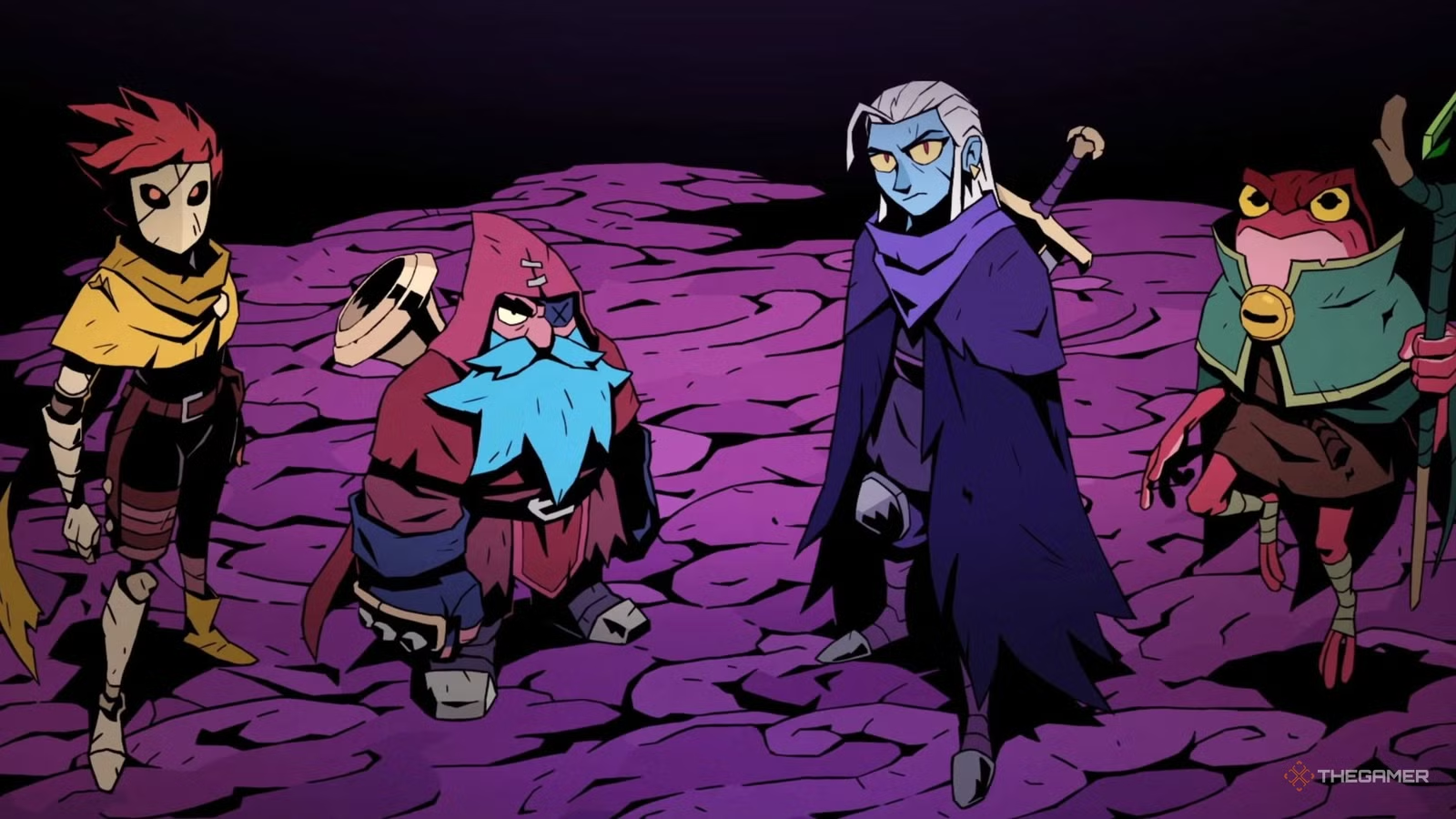
There are items and unlocks to track, gameplay modifiers, and a range of characters to choose from. The different playable characters are all villagers who are working together to defeat Pyrene and her demonic friends. Each one plays differently, which gives the game plenty of variety and each new run will require a tactical rethink. One has low health but big shields, another causes wind to blow cards around the play space and change the layout, and there’s one who can morph into a bear once a meter has been filled.
Your future is in the cards
As you explore you’ll have plenty of chances to improve your build. There are NPC characters who’ll upgrade your cards, and you will find artifacts that offer additional gameplay bonuses. New items unlock over time, widening the pool of potential tactical options and infusing each run with an element of unpredictability.

There are also status effects that don’t have an immediate impact, but rather come into play when it’s time to spend the night. For example, you might inflict bleed or poison damage on an enemy, and when you hit the button and rest for the night, that damage is taken from the enemy’s health bar, ready for you to tackle the following day.
There is so much to think about, but if you find it too easy, there are loads of gameplay modifiers to choose from. At first I had one activated that let me restart an area if I died during an encounter, however, I quickly became confident enough that I was able to take off the training wheels. One the other side of the scale, there are various options to make the game more challenging, although I didn’t dabble with any of those.
There is so much to contemplate during a run through Pyrene, and I found it to be a most addictive deckbuilder. It’s full of interesting mechanics and the distinctive art style gives it so much personality. The audio is also memorable thanks to the game’s serene soundtrack, and overall I was really impressed by the quality and implementation of the audio-visual elements.
I might not know how to say Pyrene properly – I think it’s pronounced pir-in-ee but I’m still not sure – but at this stage it doesn’t matter. However you call it, Two Tiny Dice has crafted an excellent roguelite deckbuilder that dares to be different and delivers on its promise with deep strategy, big replayability, and excellent presentation. I think you can consider that a hearty recommendation.
Pyrene is out on September 13 on PC Steam (Mac, Win) and I played the game via access provided by publisher Indie Asylum and their PR friends.