Before I got my hands on Tales & Tactics, I hadn’t really spent much time playing auto-battlers. My experience with the genre comes from professional curiosity (watching trailers and reading articles) and playing a couple of demos here and there. I certainly haven’t reviewed one until now, and I guess I’m leading with this because I want to be transparent about my relative lack of experience in this sub-genre.
Having said that, I’m still pretty confident in my opinion of Tales & Tactics, which I’ve played for more than a dozen hours by now. During that time I’ve gotten to grips with (most of) its many interlinking systems, unlocked all of the additional characters and traits, and read more than my fair share of text boxes. There’s a lot to unpack.
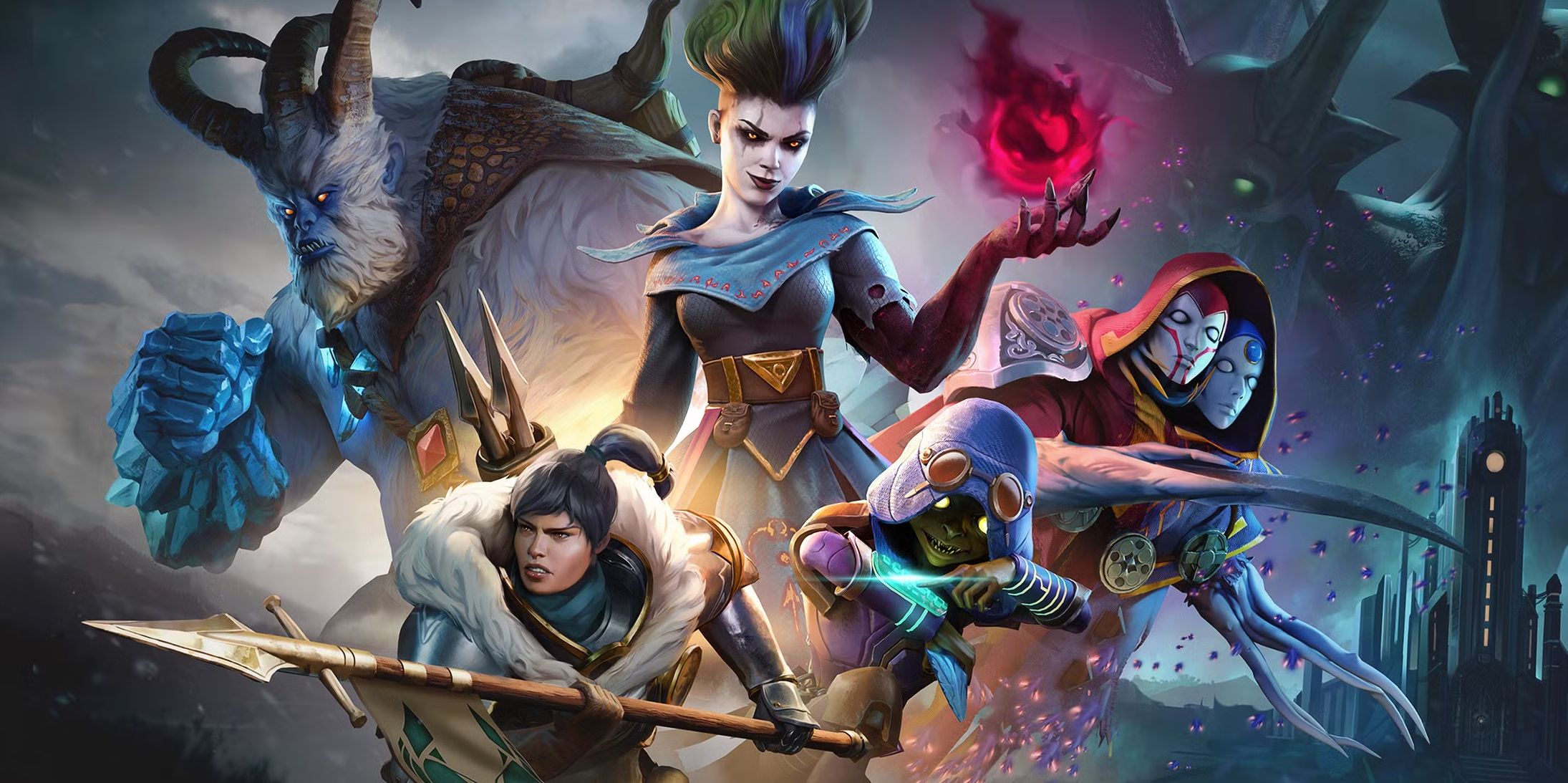
In the midst of that initial chaos, I discovered a roguish auto-battler with a strong tabletop gaming aesthetic. The action takes place on a board game-style hex-based arena, with miniature units that draw inspiration from all aspects of fantasy folklore. In short, it looks lovely.

Telling tales and tactful tactics
There are two sides to this game, as implied by the title. The “Tales” half of things is represented as a choose-your-own-adventure of sorts, where you meet the denizens of this fantasy world, visit a variety of locations, and therein compete with AI players for a place in the so-called Grand Tournament.
The “Tactics” part of the game is as described above: a tabletop battlefield where two teams duke it out in real-time combat encounters. Starting there, I think it’s fair to say that this is a game about finding marginal gains and exploiting enemy weaknesses. Your team is made up of several units, depicted as tabletop miniatures that you can position anywhere on your half of the board. However, this ain’t no turn-based tactics game, and once you press start, your little minis spring into life and go in search of a battle in real-time.
The aforementioned marginal gains come from team building, which we’ll get into shortly, but also from simple positioning. Your team is made up of both melee and ranged units, and there are subtle sub-classes and different traits in the mix, too. It’s essential that you put the right units against the correct opponent, as a mismatch will likely lose you the game.

Once you start combat all hell breaks loose, and your previous planning is brought to bear in real-time. Like a team manager standing on the sidelines, you’re forced to watch on as your units tear into their opposite numbers. It’s in these fleeting seconds that you discover how effective your positioning has been, or whether you’ve underestimated your opponent.
Building a team
The best way to ensure success on the battlefield is to build a team filled with powerful units that synergise well with one another. At the very start of each run you’re notified of the randomised elements that will impact events to come, and then given the opportunity to build a plan around said elements.
Each run is made up of several combat encounters, and every one of them means a different challenge. At the start of your run and then again before each round, you’re given a pool of different units to choose from. You can buy new characters with “stars” and this limited supply of stars is also used to replenish the store with more units, so you’ll only see a small number of units during the draft phase.
I sometimes found the earliest stages of team building to be a little frustrating as you ideally need three of the same unit from the character pool. Once you’ve got three the same they merge into one upgraded unit. Thus, assembling a strong team at the start sometimes feels like it’s in the lap of the gods, and if you don’t get a good starting hand, so to speak, it’s very easy to lose the first match and begin your campaign on the back foot.
However, if you’re lucky and get enough duplicates to upgrade one or even two units, and if those units synergise nicely against your opponents and the overall game state, those first battles can be a breeze. What’s more, there are several different classes and unit types that pop up in the draft, and fielding characters from the same groups or with the same traits can also unlock gameplay buffs.

Once you’ve got a good team things improve dramatically. You might have a couple of upgraded units that get a health bump, and you can also equip your units with weapons and banners, granting both passive and active bonuses. It’s in these seemingly minor decisions that you’ll unlock the marginal gains I mentioned earlier, and there is a whole lot of depth for players to explore and experiment with.
A very storied adventure
There is one aspect of the game that didn’t land with me and that’s the “Tales” alluded to in the title. My main bit of feedback for the devs is that, in my opinion, there’s too much text in the game. I’m not against lots of writing and detailed storytelling in video games, but in this case I didn’t feel like much of what I was reading made any material difference to my enjoyment of the game and a lot of it could have been left on the cutting room floor.
Having said that, you could argue that it’s nice to have the extra flavour for those who want it, and it’s not a disaster by any means, it’s just a bit much. Tales & Tactics has a lot of personality and the overall setting is great – there’s a real sense of place as you sit down to start another game at the table. In fact, the atmosphere that Table 9 Studios has managed to build into this fantasy world is admirable and certainly one of its finer points.
I also need to compliment the number of options open to the player in terms of in-game customisation. There are a whole bunch of difficulty levels for advanced players to attempt, and gentler options and modifiers for those of us who prefer the stakes a little lower.
Beyond the difficulty settings, there are also a bunch of playable characters to unlock, giving you even more potential variety as you’re playing. There’s a whole lot of game here if you want it, and I’ve not even touched on the fact that there’s multiplayer – with both ranked and casual playlists – so you can test your build skills against those of your fellow rogues, should you so wish.
I must admit, I wasn’t at all sure about Tales & Tactics at first, and it took several hours for me to warm up to it. However, once I’d learned the rules, unlocked everything, and started to experiment with different builds, and on those occasions where I got the rub of the green early on, I had a really good time. It was those moments that drove me on and pushed me to discover the game’s true spirit, and while I can’t say how it compares to the best auto-battlers, I can confirm that the longer I played the more engrossed I became in this fantasy world and its intricate machinations.